
Sneaky setter gestures
This may not be clearly seen but with every rotation and point the players might keep their hands on their back and signal the other players of the formation they would be using. THis is usually done by the setter and the players in the front zone and the objective is to do it in a way that the opposition doesn't notice it. Moreover the signals may be a formation that is entirely creative made by the team or some common ones include engaging the mid blocker, the pipe, opposite, white ball, outside, quick sets, X play where two hitter approach, double quick set which is a bit quicker, 3 for setting the ball a bit higher to the outside hitter and there are endless possibilities and combinations that the teams use to gain points and win sets. The signals can be made in a way that it isn't visible as well that is why they are super sneaky.

Never confuse yourself!
It is a saying that if you confuse yourself then you will confuse others and it stays true in volleyball as well because the game is such that if you get confused your team loses points. A simple trick to judging the ball is that if you are standing in the back zone on positions like 1,5 and 6 then just make sure that the ball that is served or hit is below your chest and head which means that you have to receive it but if it isn't then leave it because it is outside. Another judgement is that if you are close to the side lines then just measure the distance to where you are standing using your steps which would help you image and leave the unwanted balls. Another confusion is whether the coming ball is to be taken through an overhead pass or underhand for which the same principle applies where if the ball is above your chest then play overhead and if it's under then play it with underhand. Make sure that you reach the ball as quickly as possible and receive it when you are stationed on the ground to make sure that the pass is properly oriented.
A perfect team work
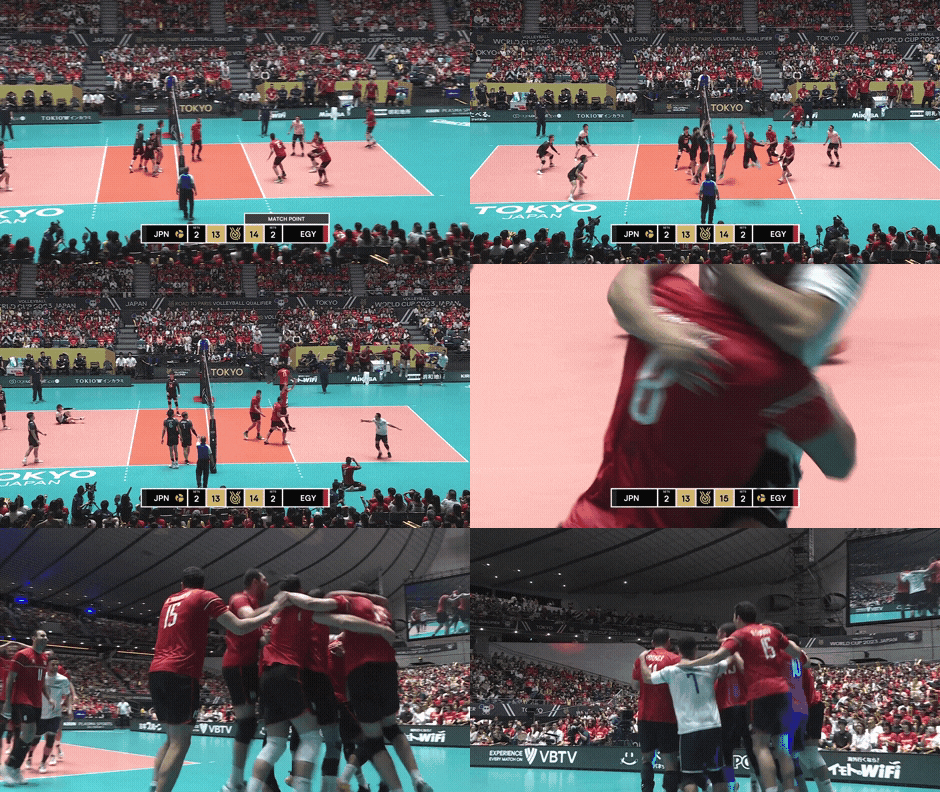
A perfect teamwork is what sparks the game. With proper and clear communication and proper team chemistry. This includes the setter signals as well as verbal communications which include instances when the ball is hit between 2 players and the best thing to do to avoid miscommunication is to call out that you are taking the pass. And this can be practiced both verbally and non verbally when the team is practicing a drill called tapping where the players divide equally in front of each other and they can decide which side would be tapping(spiking) the ball and which side would be defending the ball.

The art of serving
Serving is like the first step of the game. Without it nothing can be done because it is what starts the game. Now it is very important to make sure that the serve which you serve is at it's best because if the opposite team isn't able to receive it properly then it is termed as a "rally break" which disrupts the ideal pass flow of the opposite team which is perfect for the other team to attack because the formation of the opposite team is messed up. Another thing that can be done is targeting a spot or a player who is weak at receiving the serve and this would aid in the points being gained the more serves you do the more points are gained and if services are aced then the rotation doesn't happen. It is also very important to note which service you are going to and randomly use different services to make them more effective.

Tricking the blockers
It is very heartbreaking when you spike but your ball is blocked by the blockers. This is common against spikers and even the best hitters have faced the same problem but a way to decrease it is to hit at different heights and communicate it to the setter through signals, moreover the hitting angle can be changed to suppress the ball to fall in the area of 2 and 1 or from the other side 4 and 5 because the extreme angle is hard to hit but with a ball with more height it is comparatively easy. Moreover the timing should be proper between all the players and everyone should be prepared for the worst to make sure that they can receive the blocked ball as well and come back into formation.

How to servive a rally
Every sport needs endurance and it is intense in volleyball as well. Since there are many sets to win and each set is 15 to 25 points depending on the tournament it can get really exhausting because sometimes rallies last for 2 minutes which in volleyball is really great as the average is 4-7 seconds. To survive long rallies try to focus on the ball and call out when you are receiving it. Next follow the ball and face it's direction when it is being spiked and if every player does that in the back row then a C would be formed and for the front row the mid blocker would be behind the setter and the blockers at the angle where the blocked ball can be received and maintaining this state is crucial for long rallies and coming up with a weak spot on the opposite teams court. The transition from this defense position to attack position should be quick, giving less time to the opposing team to return to defense and allowing them to attack and take points.